
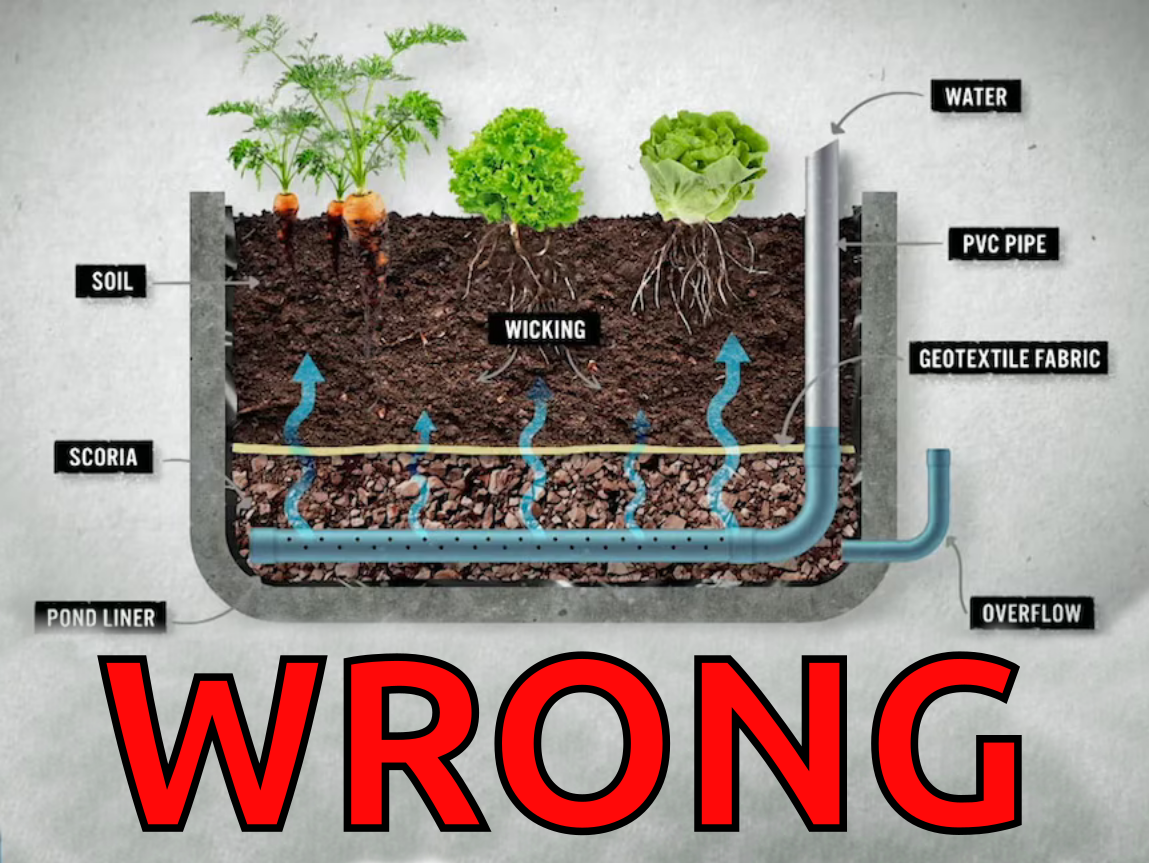
Many so-called “wicking beds” found on the internet fail to wick properly by using stones or sand to keep the soil away from the storage pipe. Sadly, even the ABC showed them in its Gardening Australia series. These wrong designs stem from four misconceptions that have serious consequences.
The Misconceptions
Each of the following misconceptions are commonly spread around as fact, knowing how to avoid them results in significantly more healthy plants. While each misconception may, at face value, seem logical each one results in hidden costs and, they are built on fundamental misunderstandings about how water is meant to be stored and wicked in the beds.
Misconception 1: Soil Will Fill The Water Reservoir
This does not happen. Soil next to the reservoir pipe will not fill it when it rains or when you water from the surface. This can only occur if the outlet holes of the reservoir pipe are facing upwards or sideways.
When the outlet holes are correctly facing downward, water moves through the soil far too slowly to carry soil particles into the reservoir. Over the years, we have examined dozens of wicking boxes, including some exposed to the heavy rain and flooding of 2011 and 2013. Only a few contained small amounts of soil in the reservoir pipe, and even then, it was no more than a handful.
Misconception 2: There Is More Water For The Plants When Cloth Covers Stones And Soil Is Kept Out
It is the opposite. Soil holds around 40% more water than the commonly used mixture of stones, sand, and water. We demonstrate this in Simple Demonstrations to Do at Home.
Misconception 3: A Cloth Does Not Stop Wicking
Cloth does not wick water. Plant taproots can grow between the bed walls and the cloth and draw water from the reservoir. As this lowers the water level, an air gap forms.
Air does not wick water. Once the connection is broken, wicking stops and the soil can dry out even though there is still plenty of water in the reservoir.
Filling the reservoir with soil allows the soil to always be in constant contact with the water, allowing the plants and the soil access to the entire reservoir.
We also demonstrate this in Simple Demonstrations to Do at Home.
Misconception 4: The Bottom Layer Will Become Waterlogged
Wicking beds do not become permanently waterlogged at the bottom. Water does not simply remain there indefinitely. Plants use water through transpiration, while evaporation from the soil surface also removes moisture. As water is used, air containing oxygen moves back into the soil.
Even without plants, natural evaporation from the soil surface is enough to prevent permanent waterlogging.
The Hidden Costs
The five costs of using cloth and stones are not always obvious, but they are important. These misconceptions and hidden costs can undermine, and in some cases completely eliminate, the main benefits of using a wicking bed in the first place.
Soil Holds More Water Than If The Same Space Is Filled With Sand Or Stones
This is counterintuitive as the water between stones and grains of sand is visible, but the water in soil is not. In soil there are millions of microscopically small holes filled with water after excess water has drained away. That water hangs on to soil particles and organic matter. The total amount of that water is larger than that in the open spaces between rocks and sand. This has been demonstrated in both our personal testing and by the University of New England.
No Roots And No Soil Biology In Stones, Sand, or Water
Healthy, thriving soil biology is essential for healthy plants—the more, the better. Stones, sand, and free water provide little to no space for roots or active soil biology, so the space they occupy is largely wasted.
Minimal Surface Area and Shelter with Stones and Sand
Much of the soil biology requires surfaces to attach to and places to live so it is not easily washed away. Stones and sand provide far less surface area than good soil. A single spoonful of clay, when fully spread out, can have a surface area equivalent to a tennis court.
Soil biology also needs millions of tiny spaces where it can live and hide from larger predators. These micro-spaces are abundant in good soil but largely absent from stones and sand, where the spaces between particles are relatively large and open.
Using Cloth Causes Air Gaps That Stop The Wicking
Some plant roots will grow between the wall and the edge of the cloth and draw water from the reservoir. As a result, the water level drops, leaving an air gap between the cloth and the water.
This air gap is an issue because air does not wick water. The soil can then dry out even though there is still water in the pipe and between the stones. As most feeding roots are in the top 30 cm of soil, the plants may need watering while plenty of water remains in the reservoir.
This is easy to test with a dipstick, and we have demonstrated it in simple DIY tests.
Permanent Water In The Reservoir
In a badly designed wicking bed, the reservoir can hold a large amount of free water for long periods. This stagnant water can provide a breeding ground for mosquito larvae and other unwanted organisms.
By filling the bed with soil apart from the reservoir pipe, there is much less free water sitting in the bed. Instead, water is held within the soil, where it is continually used by plants and lost through evaporation. This greatly reduces the opportunity for mosquitoes to breed.
A properly functioning wicking bed does not need to retain the same water in the reservoir indefinitely. Water is continually drawn from the reservoir into the surrounding soil and then used by the plants. We still recommend fitting a mosquito mesh filter to the end of the inlet pipe to prevent mosquitoes from accessing the reservoir.
Conclusion
Using cloth, stones, and sand in wicking beds can take away their main benefits: longer periods of steady plant growth between watering, making it possible to water on weekends, and even longer periods between watering in cool weather or when plants are small.
These misconceptions reduce the available growing space, provide a less favourable environment for soil biology, can result in less healthy plants, and create a risk of mosquito breeding. At that point, the bed is essentially a conventional garden bed with some water sitting at the bottom—while providing less space for plants to grow.